NAME
x220-thermal - Thermal before/after benchmarks
SYNOPSIS
curl -LO https://marcp.xyz/scripts/thermal-collect.sh
chmod +x thermal-collect.sh
DESCRIPTION
NOTE: All thermal tests were performed at an ambient room temperature of ~22 °C.
This ThinkPad x220 was produced in April 2011 and has never had it's thermal paste replaced. Does it make any difference to do so? Lets find out.
First we measure the current thermal situation with the old paste. For that we run thermal-collect.sh to collect data. Then we disassemble the laptop and apply new thermal paste. And finally we measure the thermals again to see if anything changed.
The script logs CPU temperature, fan frequency, and fan RPM to a file; we used gnuplot to visualize the collected data.
NOTES
TLDR: Good results, this prevents the device from throttling, can recommend.
EXAMPLES
Log a run for each scenario, before and after the repaste (ctrl-c to stop):
./thermal-collect.sh idle      # baseline, machine idle
./thermal-collect.sh stress    # under load
Each run writes a CSV to /tmp/<label>-log-start-<time>; plot it with gnuplot.
RESULTS
Idle
The idle figures below show a 4.49% temperature reduction and a 45.01% reduction in fan speed (RPM).
- °Celsius
- 45.48 to 43.48 (-4.49%)
- Fan-RPM
- 2353.68 to 1488.85 (-45.01%)
- CPU (MHz)
- 2206.06 to 2200.31 (-0.26%)
In "Plot 1", we can see the temperature changes over time.

Both tests start at around 45-46 degrees Celsius. With the old thermal paste the temperature rises until it reaches a settle point of around 47 degrees Celsius. Comparing this to the new thermal paste where the temperature sinks until it settles at 43 degrees Celsius. Resulting in a reduction of 4 degrees Celsius during idle.
Stress
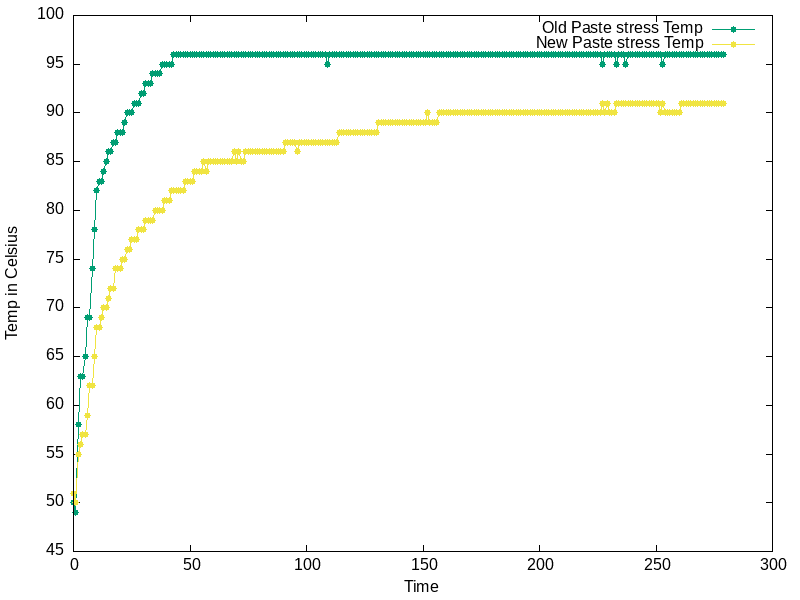
Under stress the fan speed is more comparable; it ramps up to about its max speed either way. There is a temperature improvement of 9.04%.
- °Celsius
- 93.80 to 85.68 (-9.04%)
- Fan-RPM
- 4507.1 to 4468.46 (-0.86%)
- CPU (MHz)
- 2752.11 to 3070.74 (+10.94%)
In "Plot 2" we can see that the device never reaches its limit of 95 degrees Celsius, thus it won't start to throttle dramatically.